Top Dental Hygienist: This Is The Best Way To Get Your Retainer Actually Clean In 5 Minutes
By Sarah Mitchell, RDH | May 15, 2026
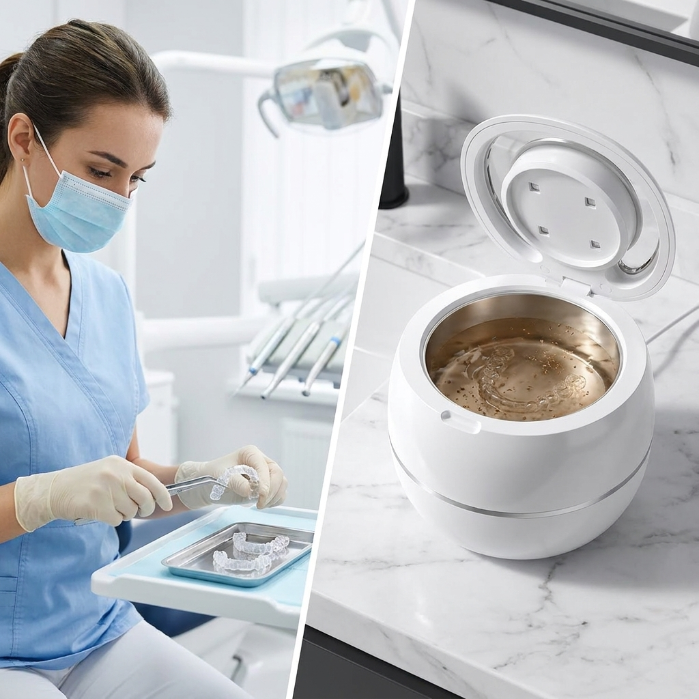
Hi, my name is Sarah Mitchell and I'm a registered dental hygienist from Portland, Oregon. I've spent 14 years in clinical practice. I've worked with over 8,000 patients — from teenagers getting their braces off to seniors adjusting to new dentures.
I've seen thousands of retainers, night guards, and aligners. And I've seen what happens to them when people think they're cleaning them properly.
But they're not.
For years, I was part of the problem. I told my patients to use cleaning tablets. I recommended the same thing every hygienist recommends.
Then I saw something that changed the way I think about oral appliance cleaning forever.
The Sour "Wet Dog" Smell Responsible Patients Can't Escape
You name it, I've seen it all. Retainers that look crystal clear but smell like a swamp. Night guards with yellow buildup crusted into the grooves. Dentures with dark brown stains that no amount of scrubbing could touch.
Patients would hand me their appliance during a checkup. I'd hold it up. Sniff it. And try not to make a face.
That smell. You know exactly what I'm talking about. That warm, sour, "something died in here" smell.
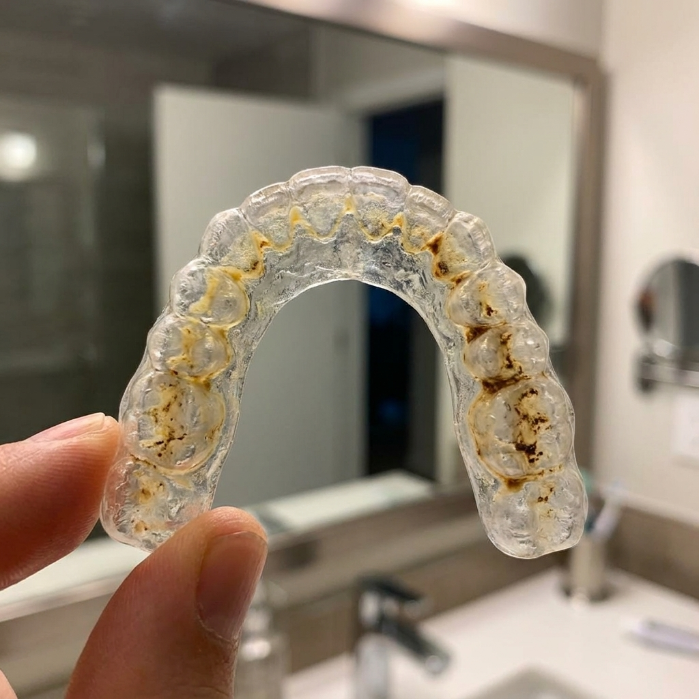
Every retainer wearer knows it. Every night guard wearer cringes at it.
And the worst part? These were the RESPONSIBLE patients. The ones who soaked their appliance every night. The ones who used the tablets I told them to use.
They were doing everything right. And it still wasn't working.
But it wasn't until I looked at my own retainer under a microscope that I finally understood why.
The Late-Night Lab Test That Exposed My Own "Clean" Retainer
It all started with a late night in the office. We had just gotten a new ultrasonic cleaning unit for our instrument lab. I was running my own retainer through it as a test — just water, no chemicals. Something I'd done a hundred times with cleaning tablets at home.
After five minutes, I pulled it out. The water was BROWN. Dark brown. Cloudy. With tiny particles floating in it.
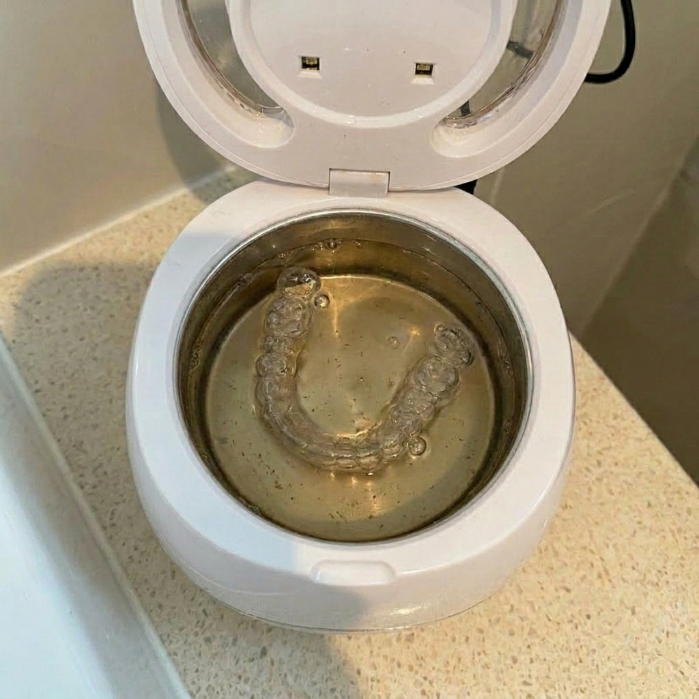
That was my retainer. The same retainer I'd been soaking in Polident every single night. The same retainer I thought was clean because it looked clear and smelled minty.
The Microscopic "Groove Trap" That Toothbrushes and Tablets Physically Can't Touch
Here's what nobody tells you about your retainer or night guard.
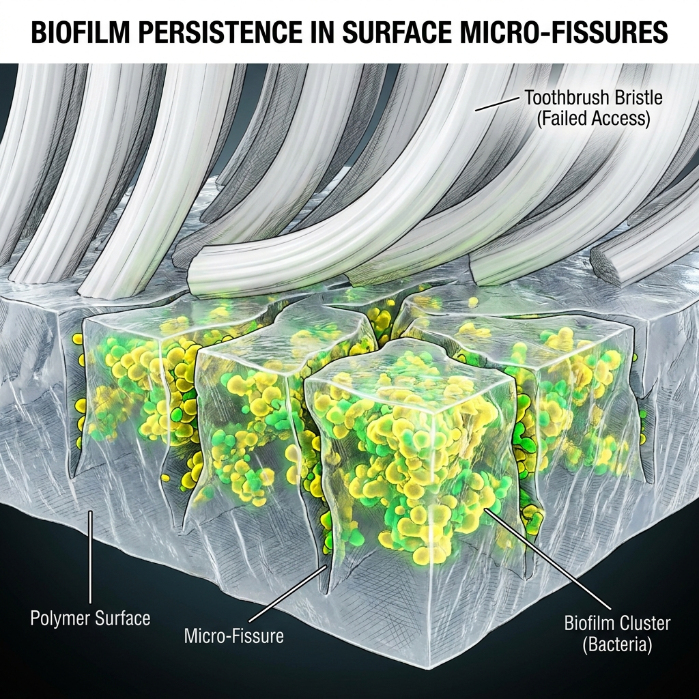
That piece of plastic has THOUSANDS of microscopic grooves, ridges, and crevices molded right into the surface. They're functional — they help the appliance grip your teeth. But they're also where the real problem lives.
Bacteria and biofilm settle into those grooves. They set up permanent colonies. They multiply. And they produce SULFUR COMPOUNDS — the stuff that creates that foul smell.
Your toothbrush bristles? They're about 100 TIMES TOO WIDE to fit inside those grooves.
Imagine trying to clean a tiny crack in your sidewalk with a broom. The broom only touches the surface. The crack stays full.
Why Cleaning Tablets Are Just Perfume For Your Appliance
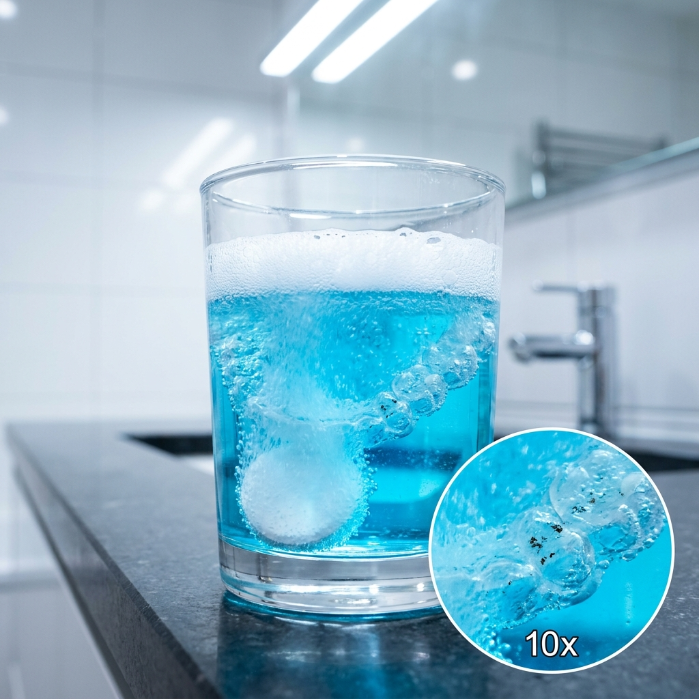
Those tablets do two things.
First, they release oxidizing chemicals that kill SOME surface bacteria. Not all. Some.
Second, they release fragrance molecules that coat your appliance in a minty-smelling layer.
So your retainer comes out smelling like a mint factory. And feeling slippery.
That slippery feeling? That's CHEMICAL RESIDUE. Not clean. Coated.
The bacteria inside the grooves? UNTOUCHED. Still there. Still multiplying.
The mint just covers it. For a few hours. Then the mint fades. And the smell comes back.
Because the source was never removed.
The FDA Warning Nobody Reads
Here's something that disturbed me. The FDA has issued warnings about persulfates — the chemical that makes cleaning tablets fizz. Persulfates can cause allergic reactions. Swollen gums. Throat irritation. Chronic night coughing.
The warnings are on the box. In tiny text. Under the ingredients nobody reads.
And we hygienists kept recommending them. Because that's what we were taught. Because what else are you going to do?
Why Your Current Cleaning Routine Is Just Perfume for Accumulated Biofilm
Let me be clear about what doesn't work.
Toothbrush and toothpaste? Bristles can't fit inside the grooves. And brushing actually creates micro-scratches in the plastic where bacteria embed even deeper.
Cleaning tablets? They perfume the surface and leave chemical residue. The bacteria in the grooves are untouched.
Mouthwash soak? Same problem. Chemicals sit on the surface. They can't physically reach inside microscopic crevices.
Hydrogen peroxide? Kills some surface bacteria. Doesn't extract biofilm from grooves. And can degrade certain plastics over time.
That's not a quality problem. That's a physics problem.
So What's The Solution?
Here's a secret not many people know — but every dental lab already does.
DENTISTS USE ULTRASONIC CLEANERS in their own offices. It's how they clean their instruments. It's how dental labs clean appliances before sending them to patients.
The technology is called CAVITATION.
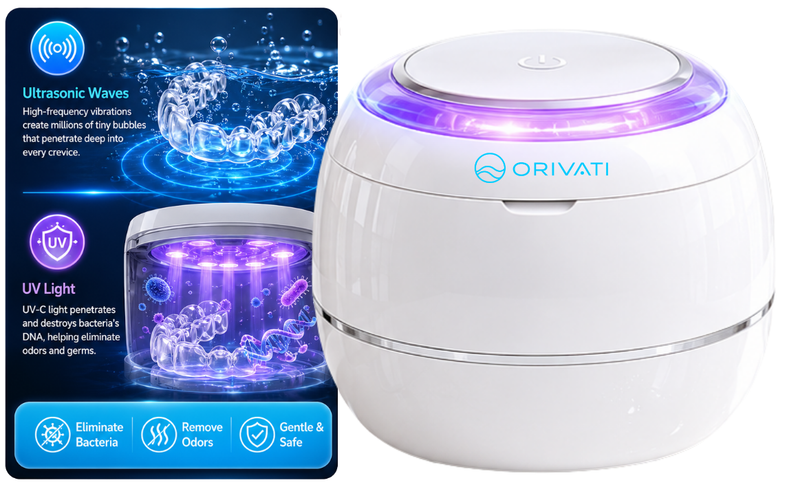
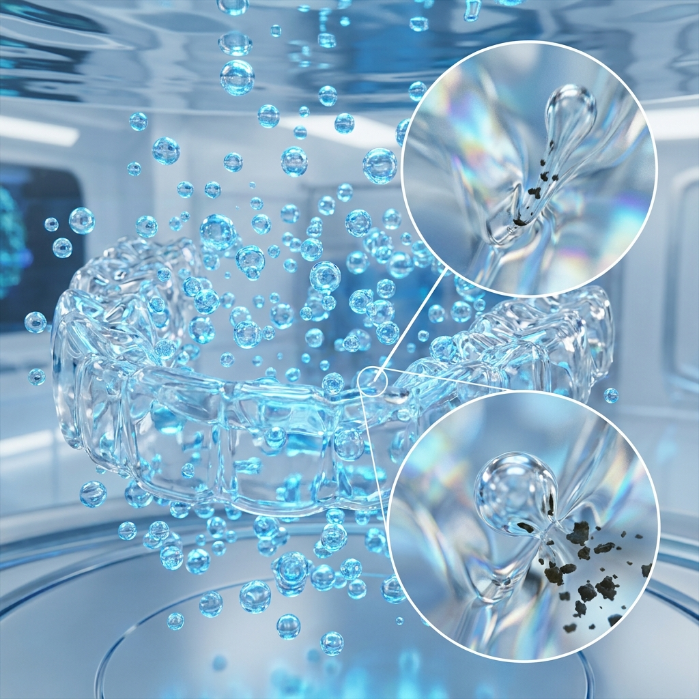
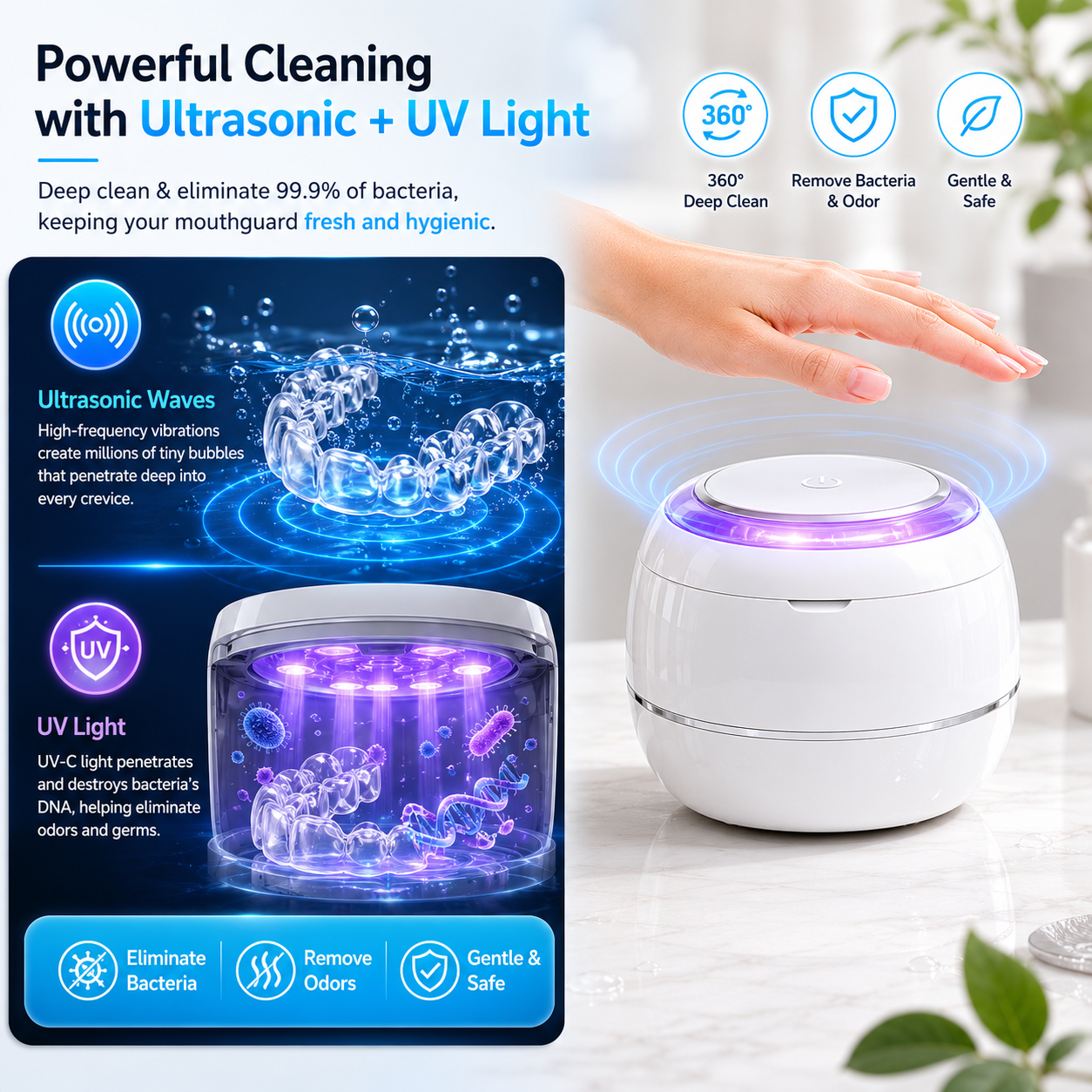
At 42,000 VIBRATIONS PER SECOND, the water in an ultrasonic cleaner creates MILLIONS OF MICROSCOPIC BUBBLES. These bubbles are small enough to fit inside those grooves your brush and tablets can't reach.
When those bubbles IMPLODE, they create a tiny vacuum. That vacuum PHYSICALLY PULLS bacteria, biofilm, and debris out of the crevices.
Not chemically. Not with fragrance. With PHYSICAL FORCE.
Then UV-C LIGHT hits the surface and deactivates whatever organisms are left, scrambling their DNA so they can't reproduce.
Meet Orivati™ ClarityPod: Professional-Grade Ultrasonic Power, Re-Engineered for Your Bathroom Counter
- 42kHz ultrasonic frequency — creates millions of cavitation bubbles that reach every groove
- UV-C light — activates automatically after ultrasonic cycle for another layer of hygiene
- 2 cleaning modes: 5-min Quick Clean (daily) and 10-min Deep Clean (heavy buildup)
- 180ML capacity — fits retainers, night guards, dentures, aligners
- Plain water only — no chemicals, no residue
- BPA-free materials, AC-powered with standard U.S. plug
- Compact design fits any bathroom counter
"I Was Honestly Shocked" — What Real Appliance Wearers Are Saying After Their First Cycle
Dental professionals across the country are endorsing ultrasonic cleaning for oral appliances. It's the same technology they've trusted in their own offices for years — now available for home use.
But the numbers that matter most are the ones real customers describe.
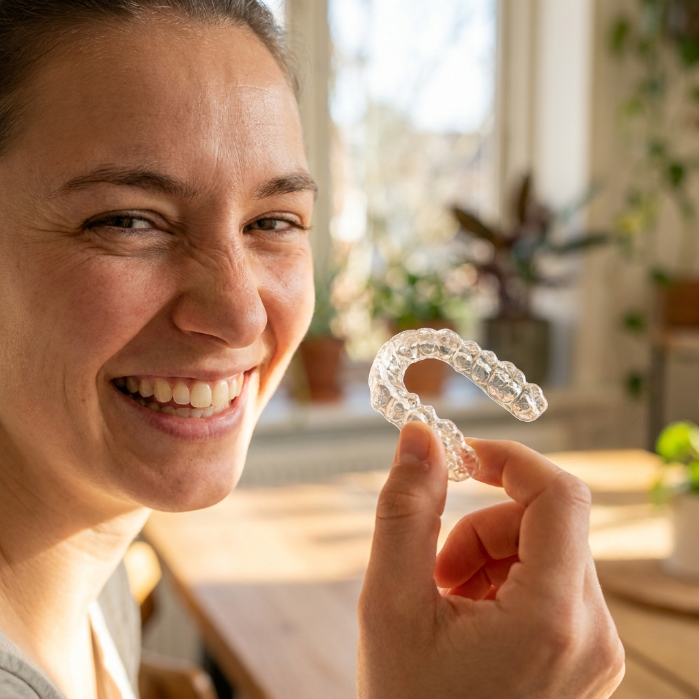
These aren't paid testimonials. These are real people who saw brown water come off a retainer they thought was clean. And they never went back to tablets.
Why These Precision Dental-Grade Units Are Constantly Sold Out
Here's something you should know.
The manufacturer produces these in limited batches. Each unit requires a calibrated piezoelectric transducer — the component that creates true ultrasonic cavitation. These aren't cheap vibration motors that anyone can source. They're precision components.
Right now, demand is outpacing supply. During promotional periods, inventory has sold out in under 72 hours.
We could sell out tomorrow. I'm not saying that to pressure you. I'm saying it because I've seen it happen. Patients who waited to order had to wait 3-4 weeks for the next batch.
If your retainer still smells after tablets, every night you wait is another night you're putting a bacteria-covered appliance back in your mouth. The buildup doesn't pause while you decide.
The Math Doesn't Lie: How This One-Time Purchase Pays For Itself in Months
This is where most people expect a $300 price tag. After all, dental-grade ultrasonic cleaners cost that much. And you're getting the same core technology in a home device.
But this unit is priced at $89.95 Direct to consumer. No dental office markup. No middleman.
Let me put that in perspective.
Cleaning tablets cost $60 to $100 per year. You buy them every month. They run out. You buy more. And they don't even clean your retainer — they just perfume it.
This device costs less than one year of tablets. And it actually cleans. After 6-9 months, it has paid for itself in tablet savings alone.
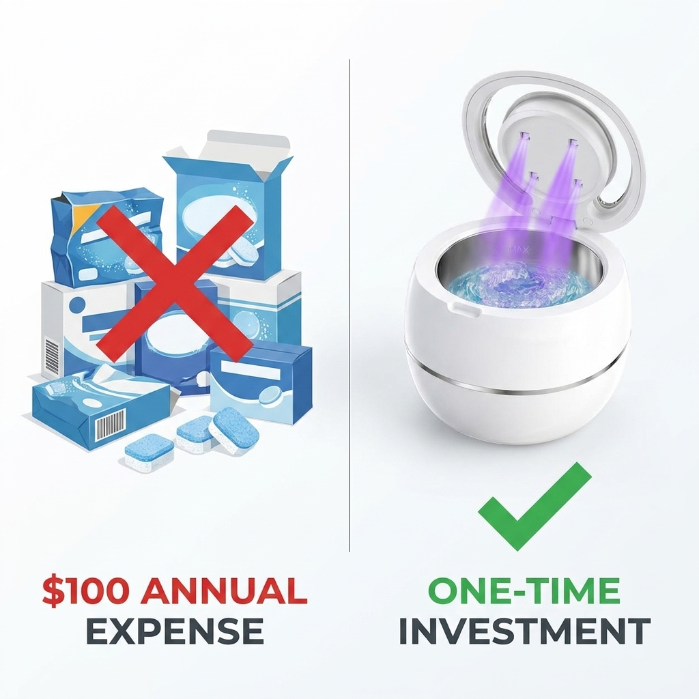
One dental visit for a professional cleaning costs $75-$200 without insurance. This costs less than a single visit.
Your retainer cost $200-$500. Your night guard cost $300-$800. This $89.95 device protects that investment by actually keeping it clean.
Cost per use: If you use it once a day for a year, that's about $0.25 per clean. Less than a single cleaning tablet.
And if you buy the 2-pack (one for you, one for your partner or parent), you get both for $159.95. Free shipping on every order.
Take the "5-Minute Water Test" Entirely At Our Risk
I know you might be skeptical. I was too. I'm a hygienist. I didn't believe a home device could do what our $400 office unit does.
But here's the thing: you don't have to take my word for it.
The manufacturer offers a full 30-day money-back guarantee. No questions asked. If you use it and your appliance still smells, return it. If the water doesn't turn brown on the first cycle, return it. If you just change your mind, return it.
It's completely risk-free. You either see proof that it works — the brown water is undeniable — or you get every penny back.
Here's my personal test: Soak your retainer in a cleaning tablet tonight, like you always do. Tomorrow morning, drop it in this ultrasonic cleaner with plain water. Press start. Wait five minutes.
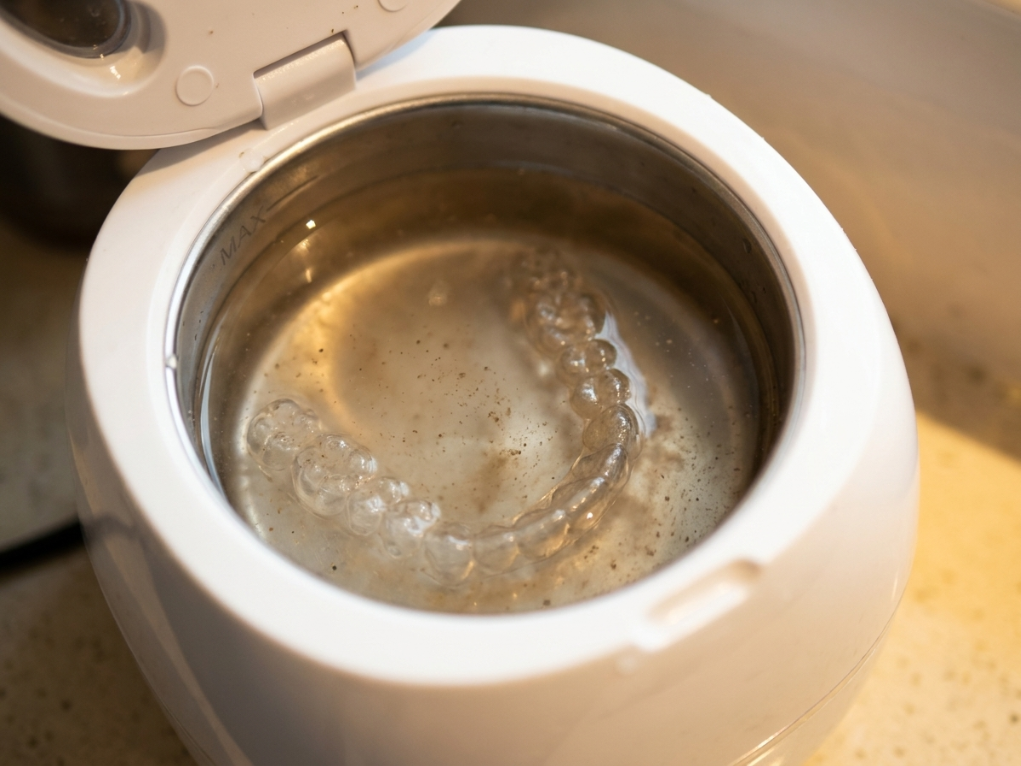
Look at the water.
That's all the proof you need.
Stop Putting Bacteria-Covered Plastic Back Into Your Mouth Every Single Night
Remember, there is ZERO risk. You have 30 days to try it. If it doesn't work, you get your money back. Period.
But think about what happens if you don't try it.
Tonight, you'll soak your retainer in a tablet. Tomorrow morning, you'll take it out. It'll smell minty. You'll put it in your mouth.
And the bacteria in those microscopic grooves — the ones the tablet couldn't reach — will still be there. Still multiplying. Still producing the sulfur compounds that make your retainer stink by dinnertime.
Every night you wait, that buildup gets worse. The biofilm gets thicker. The grooves get more colonized.
Your partner might be polite about it. But you know the smell is there. You do the smell test every morning. You cringe every time. And you keep doing the same thing hoping for a different result.
Dental professionals recommend this type of cleaning. Real hygienists and dentists. Not influencers. Not paid actors. People who see what happens to retainers every single day.
This is about $89.95 Less than a year of tablets that don't work. Five minutes a morning. And the proof is in the water.
If you use a retainer, night guard, or denture, you shouldn't clean your jewelry in the exact same water.
Grab our Multi-Purpose Bundle (2 Units) for just $159.95 to get 10% off:
- Keep one dedicated purely to your oral appliances
- Use the other for your rings, necklaces, and watches
Cleaning for the whole household? Secure our Family Bundle (3 Units) for only $229.95 to save 15% — so your loved ones can enjoy their own pristine, worry-free clean instead of paying $89.95 for a single unit.
Claim Your Orivati™ ClarityPod While Current Batches Last
1. Click the button below
2. Select your quantity
3. Arrives in 7-10 business days
4. Drop your "clean" retainer in. Add water. Press start. See the proof.